Cottage windows scrappy quilt: big soft squares framed by little scrappy squares (48 × 60 inches)
🖨️ Prefer to sew from paper? Printable PDF patterns are in our Etsy shop ↗
Big squares in sage, rust, cream and blue, each framed by a ring of little plaid and floral squares. Twenty easy blocks, finished at 48 × 60 inches.
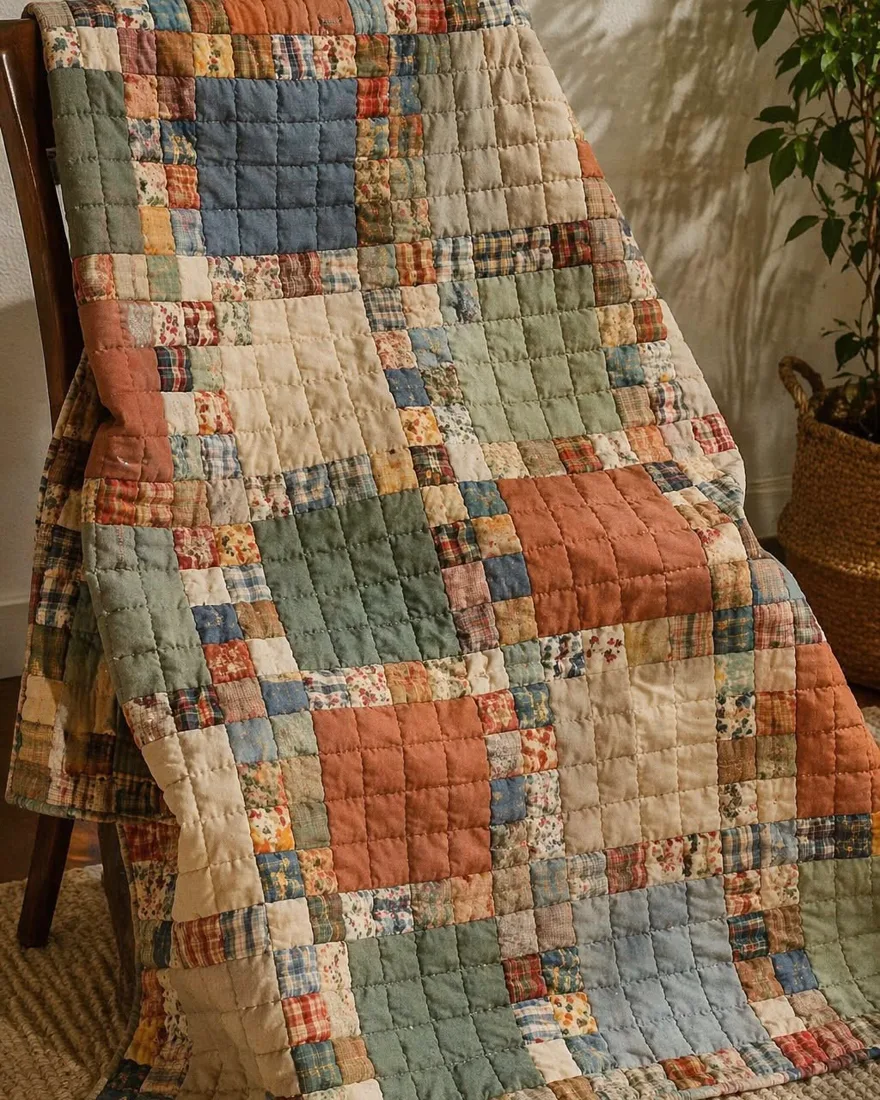
Big quiet squares, busy little ones
Each block in this quilt is one big, calm square in a ring of tiny scrappy squares, like a cottage window with a patchwork frame. Put the blocks side by side and the little squares join up into a cheerful lattice.
Sage, rust, cream and two soft blues keep the big squares restful, while the little plaids, checks and florals use up every scrap in the basket. It feels old and loved from the very first day.
Quilt size and what it is made of
All measurements include a ¼-inch seam allowance unless they say finished.
| Part | Size | How many |
|---|---|---|
| Quilt | 48 × 60 in finished | 1 |
| Blocks (4 across, 5 down) | 12½ in (12 in finished) | 20 |
| Big squares | 8½ in (8 in finished) | 20 |
| Little squares | 2½ in (2 in finished) | 400 |
| Binding | 2½ in strips | 6 |
Fabric and supplies
Amounts assume fabric about 42 inches wide with at least 40 usable inches. Faded, washed-looking solids for the big squares give the soft look of the quilt in the photo.
- Scraps for the little squares (plaids, checks, small florals, warm and cool): 1⅞ yards in total, or 26 strips 2½ × 40 inches, or 400 squares 2½ inches
- Sage green: ½ yard
- Rust: ½ yard
- Cream: ½ yard
- Denim blue and light blue: ¼ yard each (or ⅓ yard of one blue)
- Binding (a plaid or a scrap mix): ½ yard
- Backing: 3¼ yards
- Batting: 56 × 68 inches
Step 1: Cut everything
Cut 26 strips 2½ inches wide from your scraps (or 400 squares 2½ inches if your scraps are small). From each big-square fabric, cut strips 8½ inches wide and cut them into 8½-inch squares (4 per strip): 6 sage, 5 rust, 5 cream and 4 blue. Cut 6 binding strips 2½ inches wide.
| Fabric | Cut | How many |
|---|---|---|
| Scraps | 2½ in strips (or 400 squares 2½ in) | 26 |
| Sage | 8½ in squares | 6 |
| Rust | 8½ in squares | 5 |
| Cream | 8½ in squares | 5 |
| Blues | 8½ in squares (2 denim, 2 light) | 4 |
| Binding | 2½ in strips | 6 |
Step 2: Strip-piece the little squares
Sew the 26 scrap strips together in 13 pairs, mixing light and dark, warm and cool. Press toward the darker strip. Cut each strip set into 2½-inch slices: every set gives 16 little two-square pieces, 208 in all (you need 200).
Join two pieces to make a strip of 4 squares (8½ inches long) and three pieces to make a strip of 6 squares (12½ inches long). Make 40 of each, flipping pieces end for end so the same two fabrics do not sit side by side.
Step 3: Sew 20 blocks
Sew a 4-square strip to the left and right sides of a big square and press toward the big square. Then sew a 6-square strip to the top and bottom and press toward the center. Each block measures 12½ inches.
Step 4: Lay out and join the blocks
Lay out the blocks in 5 rows of 4. A good plan from top to bottom: sage, denim, cream, sage; rust, cream, sage, rust; light blue, sage, rust, cream; sage, rust, cream, denim; cream, light blue, sage, rust.
Sew the blocks of each row together (each row measures 48½ inches), pressing the seams of odd rows to the right and even rows to the left. Join the rows. The quilt top measures 48½ × 60½ inches. Where blocks meet, the little squares form bands two squares wide, and the outside edge is one square wide.
Quilt and bind
Cut the backing into two 56-inch lengths and sew them side by side along the long edges. Layer the backing, batting and top, and baste. Quilting a grid of straight lines 2 inches apart, right along the little squares and across the big ones, gives the cozy hand-quilted look of the quilt in the photo.
Join the 6 binding strips, fold them in half lengthwise and bind. A wash after binding makes the quilt soft and crinkly.
Fixing common problems
Lots of little seams, but each one is easy. These checks help.
- Rings that do not fit the big square: measure a 4-square strip; it should be 8½ inches. If it is longer, sew those seams a thread wider.
- Blocks of different sizes: trim every block to 12½ inches before joining the rows.
- Corners that do not meet between blocks: press the rows in opposite directions and pin at every block seam.
- Two big squares of the same color side by side: lay all 20 blocks out and take a photo before you sew the rows.
Final thoughts
Twenty big squares and a pile of tiny scraps become a quilt that looks like it has been in the family for years. Want more cozy projects with every measurement worked out? Our printable PDF patterns are waiting in our Etsy shop, and our free guides are always here.