Half double and double crochet: two stitches, two rhythms
Learn the different pull-through sequences for US half double and double crochet, with explicit turning-chain rules for practice.
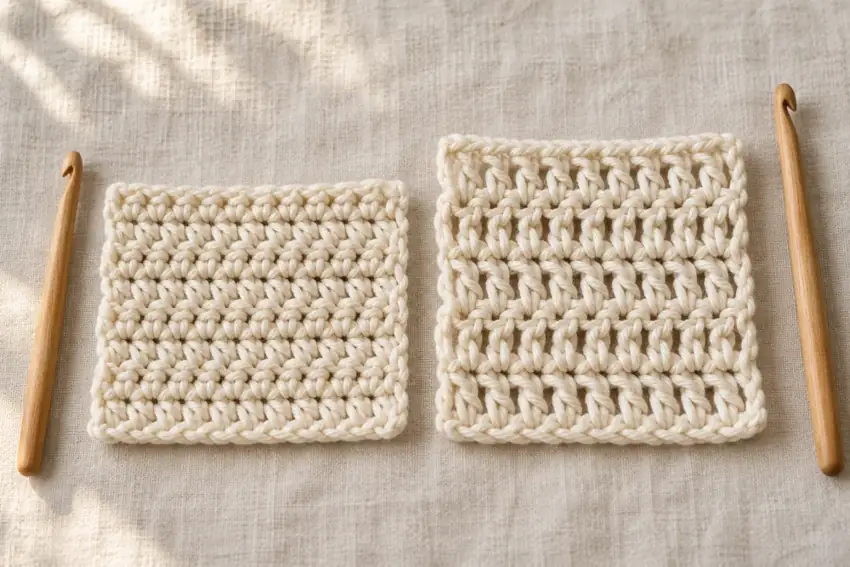
Start from a base you already understand
These are US crochet terms: half double crochet is hdc, and double crochet is dc. Both begin with a yarn over before you insert the hook. The difference comes when you close the stitch. Half double crochet closes three loops together; double crochet closes two loops, then two loops again.
Make two separate little practice bases, each with a row of ten single crochets. You can do this by chaining eleven and single crocheting in the second chain from the hook and each remaining chain. Keep a marker ready for each edge. Using an existing row lets you study the new stitch without also learning a different foundation-chain setup. These practice instructions have not been physically maker-tested by Cozy Pattern Lane.
Try half double crochet
For this exercise, chain two and turn. The chain-two provides height but does not count as a stitch. Yarn over, insert the hook under both top loops of the first single crochet, yarn over again and draw a loop through that stitch. There are three loops on the hook.
Yarn over and draw through all three loops in one movement. One half double crochet is complete. Make one hdc in each remaining single crochet. You have ten hdc; the chain-two is excluded from that total. Mark the first and last hdc, not the chains.
For the next row, chain two, turn and make one hdc in each hdc across, beginning in the first marked stitch. Skip the old turning chain at the far edge. Keep the count at ten. If the three-loop pull-through catches, make sure the hook head is turned to pass through the loops rather than forcing it. Practice with relaxed hands and stop if gripping becomes uncomfortable.
Try double crochet on the second base
Use your other ten-stitch single-crochet base. For this exercise, chain three and turn. Unlike the hdc exercise, this chain-three counts as the first dc of the new row. Mark its top chain. Skip the first single crochet below the chain-three and work your first actual dc into the second single crochet.
To make a dc, yarn over, insert the hook into the indicated stitch, yarn over and pull up a loop: three loops are on the hook. Yarn over and draw through two loops: two remain. Yarn over and draw through those two loops. You have made one dc. Work one dc in each remaining base stitch.
Count the chain-three as one stitch plus nine actual double crochets: ten stitches in total. When counting, check both the top loops and the taller stitch posts. They can help you distinguish the chain edge from the actual stitches while the fabric is still new to you.
Give the far edge the same attention as the beginning
For the next dc row, chain three and turn. Again, the chain-three counts as the first stitch. Skip the first dc directly beneath it, then make one dc in each of the next eight actual dc stitches. Complete the row with one dc in the top chain of the previous row's marked turning chain. That is nine actual dc plus the new turning chain, keeping ten stitches.
This last placement matters. Leaving out the old turning chain makes the row shrink. Working into the first stitch as well as counting the new chain can make it grow. Move the edge markers as each new row is completed rather than trying to remember where the chain edge went.
Treat turning chains as a stated convention
Patterns do not all use the same turning-chain method. Some use a shorter chain, some exclude the chain from the count, and some replace it with another starting technique. Read the notes before transferring the rules of this exercise to a different design. The number of turning chains and whether they count are two separate questions.
Compare your two samples after a few rows. Notice the different heights, spaces and edge structures without expecting them to share the same dimensions. Record which chain convention you used. A small label saying 'hdc, chain two does not count' or 'dc, chain three counts' makes the samples useful references instead of two unidentifiable rectangles.