Mauve and mocha squares quilt: 96 vintage floral squares and a brown binding (40 × 60 inches)
🖨️ Prefer to sew from paper? Printable PDF patterns are in our Etsy shop ↗
Ninety-six 5-inch squares in plum, mauve, tan, cream, sage, gray-lilac and chocolate calicos, chain-pieced in pairs, quilted in diagonal lines and bound in brown. Finished at 40 × 60 inches.
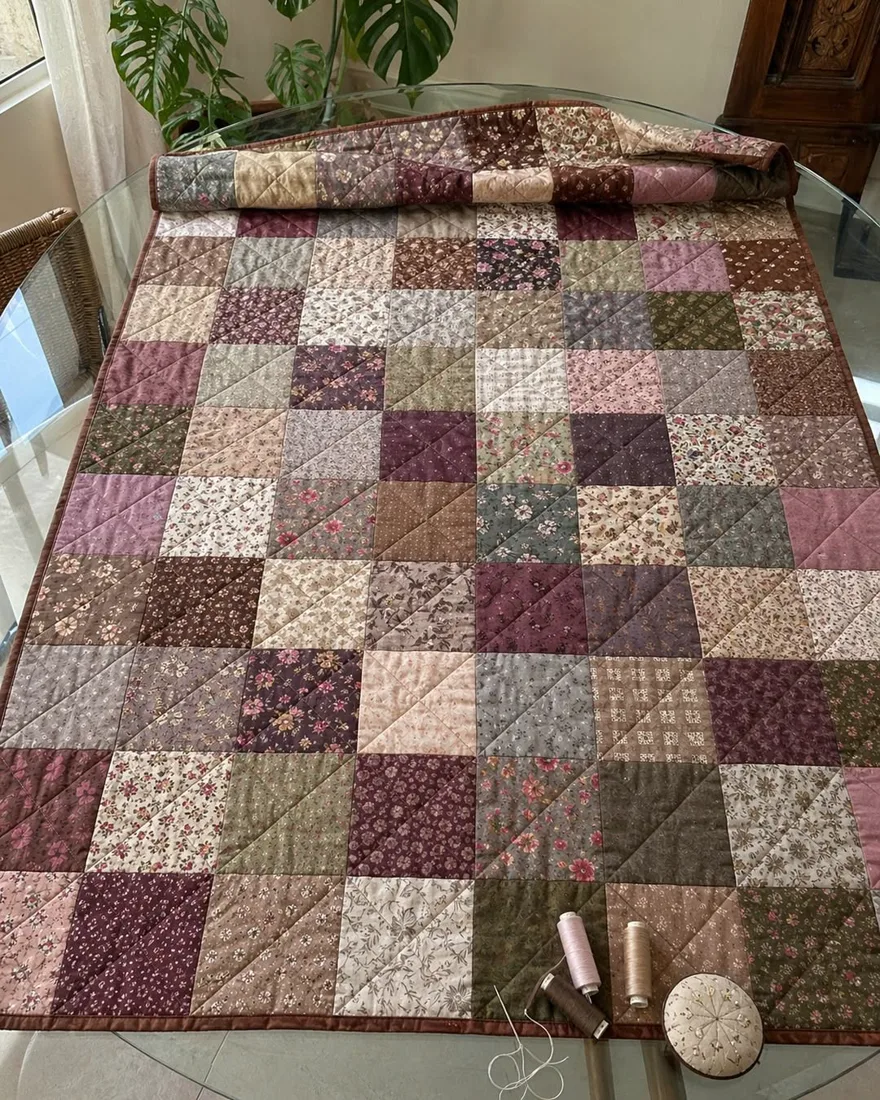
Old-rose colors in simple squares
Plum, dusty mauve, milky tan, sage and soft gray: the quilt in the photo has the colors of an old rose garden at the end of summer. Every square is a small vintage-style calico, and the gentle mix of light and dark is what makes it glow.
It is eight squares across and twelve down, with no border, a slim chocolate-brown binding and straight diagonal quilting. Long and narrow, it is just right for a sofa, the foot of a bed or a chilly porch swing.
Quilt size and what it is made of
All measurements include a ¼-inch seam allowance unless they say finished.
| Part | Size | How many |
|---|---|---|
| Quilt | 40 × 60 in finished | 1 |
| Squares | 5½ in (5 in finished) | 96 |
| Rows (8 squares each) | 5½ × 40½ in | 12 |
| Sections (4 rows each) | 40½ × 20½ in | 3 |
| Binding | brown, 2½ in strips | 6 |
Fabric and supplies
Amounts assume fabric about 42 inches wide with at least 40 usable inches. Each fat quarter gives 9 squares, so 12 fat quarters give 108 and you can leave out the ones you like least.
- Plum and wine prints: 2 fat quarters
- Mauve and dusty pink prints: 2 fat quarters
- Tan and caramel prints: 2 fat quarters
- Cream and beige florals: 2 fat quarters
- Sage and olive prints: 2 fat quarters
- Gray-lilac print: 1 fat quarter
- Chocolate brown print: 1 fat quarter
- Or, instead of fat quarters: 2¼ yards of assorted prints cut into 14 strips 5½ inches wide
- Brown for the binding: ½ yard
- Backing: 2¾ yards
- Batting: 48 × 68 inches
Step 1: Cut everything
From each fat quarter, cut three strips 5½ inches wide along the 21-inch side, then cut each strip into three 5½-inch squares: 9 squares per fat quarter. From yardage, a 5½-inch strip gives 7 squares.
Keep 96 squares: 16 plum, 16 mauve, 16 tan, 16 cream, 14 sage, 9 gray-lilac and 9 brown. From the binding fabric, cut 6 strips 2½ inches wide. Cut the backing into two 48-inch lengths.
| Fabric | Cut | How many |
|---|---|---|
| Plum and wine | 5½ in squares | 16 |
| Mauve and pink | 5½ in squares | 16 |
| Tan and caramel | 5½ in squares | 16 |
| Cream florals | 5½ in squares | 16 |
| Sage and olive | 5½ in squares | 14 |
| Gray-lilac | 5½ in squares | 9 |
| Chocolate brown | 5½ in squares | 9 |
| Brown (binding) | 2½ in strips | 6 |
| Backing | 48 in lengths | 2 |
Step 2: Lay out and chain-sew pairs
Lay all 96 squares out in 12 rows of 8, giving every row two or three dark plums or browns and a couple of light creams. Squares of the same color family should only meet at a corner.
Pick up each row in pairs: squares 1 and 2, 3 and 4, 5 and 6, 7 and 8. Feed the pairs through the machine one after another without cutting the thread, like little flags on a line. Snip them apart, wait to press, and put each row's pairs back in their places.
Step 3: Sew 12 rows
Join the four pairs of each row. Now press: all the seams of odd rows to the right, all the seams of even rows to the left. Every row measures 40½ inches.
Step 4: Join the rows in three sections
A long quilt is easier to handle in pieces. Join rows 1 to 4 into section A, rows 5 to 8 into section B and rows 9 to 12 into section C, pinning where the seams nest. Each section measures 40½ × 20½ inches.
Sew A to B, then B to C. The top measures 40½ × 60½ inches.
Step 5: Quilt and bind
Sew the two backing pieces together along a 48-inch side. You get a piece about 48 × 80 inches; turn it so the seam runs across the quilt. Layer the backing, batting and top, and baste.
The quilt in the photo is quilted in straight diagonal lines that all slant the same way: one line through the corners of each square and one more halfway between, about 1¾ inches apart. A walking foot and a chalk line every few rows keep them straight. Join the 6 brown binding strips and bind.
Fixing common problems
Long quilts need a little extra care, and these tips help.
- A quilt that skews: join the rows in three sections and check that each one measures 40½ × 20½ inches before joining them.
- A quilt that comes out short: check your ¼-inch seam; a seam just a sixteenth of an inch too wide, repeated over the 11 row seams, makes the quilt more than an inch shorter.
- Diagonal lines that drift: mark them with chalk and a long ruler, and start every line from the same side.
- Colors in clumps: take a phone photo of the layout in black-and-white mode; dark clumps show up right away.
Final thoughts
Twelve simple rows, a basket of old-rose calicos and a brown binding: a cozy quilt you can finish without a single triangle. Want more cozy projects with every measurement worked out? Our printable PDF patterns are waiting in our Etsy shop, and our free guides are always here.