Prairie patches mat: little squares, cream blocks and a soft frayed edge (20 × 32 inches)
🖨️ Prefer to sew from paper? Printable PDF patterns are in our Etsy shop ↗
Scrappy four-patches and little brick blocks in purple, green, gold and brown, with big cream floral squares stepping across in diagonal lines. No binding: the edge is stitched and washed into a soft fringe. Finished at 20 × 32 inches.
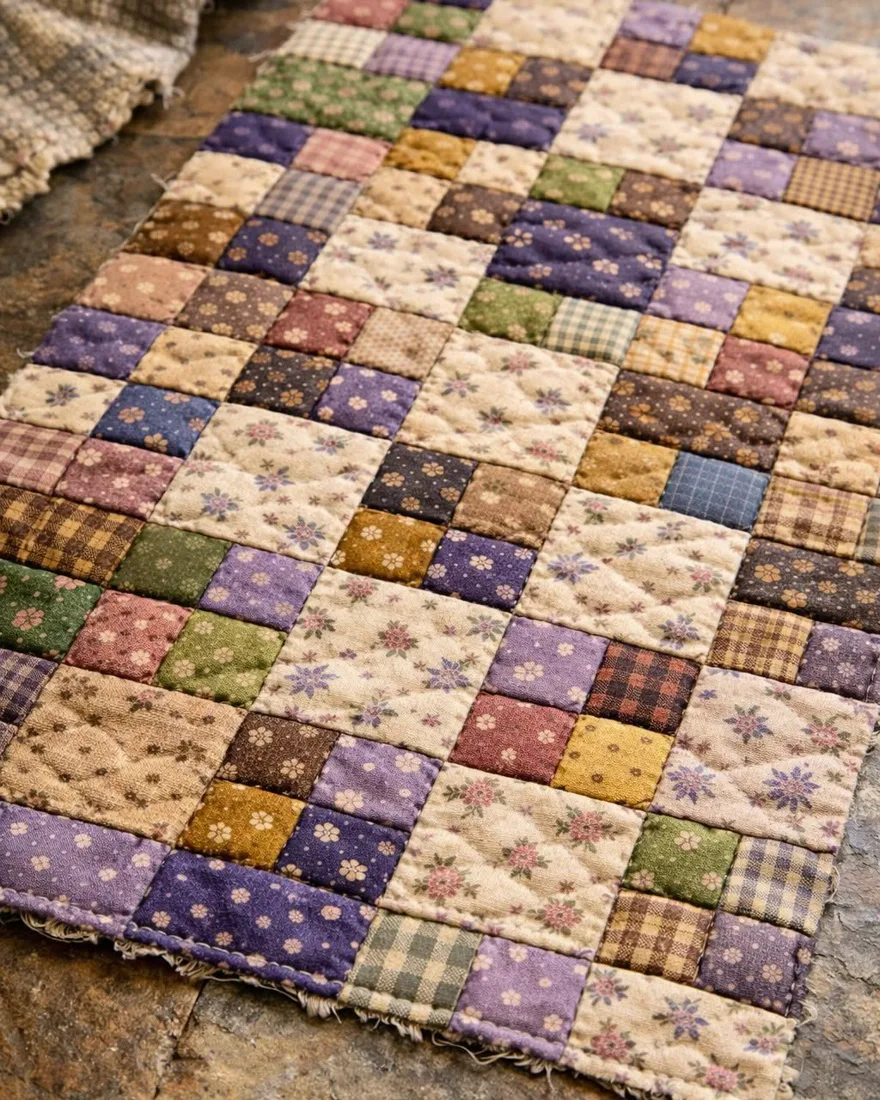
Little squares with a farmhouse feel
Purple calico, gold, moss green, rose and brown plaids: the quilt in the photo looks like it came straight out of a farmhouse scrap bag. Little 2-inch squares pair up into four-patches and short bricks, and big cream floral squares step across the mat in diagonal lines, so the eye has somewhere to rest.
There is no binding. The edge is stitched and then washed, so it frays into a soft, cozy fringe. It is a small, quick project for a table, a dresser or the end of a bed, and a lovely way to use up the smallest scraps.
Quilt size and what it is made of
All measurements include a ¼-inch seam allowance unless they say finished.
| Part | Size | How many |
|---|---|---|
| Mat | 20 × 32 in finished | 1 |
| Blocks (5 across, 8 down) | 4½ in (4 in finished) | 40 |
| Cream floral blocks | 4½ in squares | 14 |
| Four-patch blocks | four 2½ in squares each | 18 |
| Brick blocks | two 2½ × 4½ in bricks each | 8 |
| Little squares | 2½ in (2 in finished) | 72 |
| Bricks | 2½ × 4½ in (2 × 4 in finished) | 16 |
Fabric and supplies
Amounts assume fabric about 42 inches wide with at least 40 usable inches. Old-fashioned calicos, homespun plaids and gingham give the farmhouse look.
- Prints in purple, lavender, moss green, gold, rose, brown and navy, plus a few plaids: ⅝ yard in total (7 strips 2½ inches wide), or 6 fat eighths, or scraps
- Cream florals (two or three different ones look best): ⅓ yard in total
- Backing: 1¼ yards of a light cream homespun or muslin, because it shows in the fringe
- Batting: thin cotton, 28 × 40 inches (cotton fluffs up nicely at the frayed edge)
- Only if you prefer a classic bound edge: ¼ yard for the binding
- Rotary cutter, ruler, mat, pins, a walking foot if you have one, and a machine that sews a zigzag
Step 1: Cut everything
Prints: cut 7 strips 2½ inches wide, or work from scraps. Cut 72 squares 2½ inches (16 from a strip) and 16 bricks 2½ × 4½ inches (8 from a strip).
Cream: cut 2 strips 4½ inches wide, then 14 squares 4½ inches (8 from a strip). Cut the backing and the batting 28 × 40 inches each.
| Fabric | Cut | How many |
|---|---|---|
| Prints | 2½ in squares | 72 |
| Prints | 2½ × 4½ in bricks | 16 |
| Cream florals | 4½ in squares | 14 |
| Backing | 28 × 40 in | 1 |
| Batting | 28 × 40 in | 1 |
| Binding (optional) | 2½ in strips | 3 |
Step 2: Make 18 four-patches and 8 brick blocks
Four-patches: chain-sew the 2½-inch squares into 36 pairs, two different colors in each pair, and press toward the darker square. Join two pairs, turning one around so the seams nest, and press. Each four-patch measures 4½ inches. With yardage instead of scraps, sew two 2½-inch strips together and cut 2½-inch slices: one strip set gives 16 pairs.
Brick blocks: sew two bricks together along a long side and press toward the darker one. Each brick block also measures 4½ inches. In the quilt in the photo the colors never match inside a block: a purple sits beside a gold, a plaid beside a green.
Step 3: Lay out the mat
Lay the 40 blocks out in 8 rows of 5. Place the cream squares first, in diagonal lines: in row 1 they go in spaces 1 and 4, in row 2 in spaces 2 and 5, in row 3 in space 3, and then the pattern starts again. That uses all 14 cream squares, and they touch only at their corners.
Fill the other 26 spaces with the four-patches and brick blocks, spreading the 8 brick blocks around and keeping them lying sideways, like the ones in the photo. Step back and swap blocks if two purples or two golds end up side by side.
Step 4: Sew the rows
Sew the 5 blocks of each row together. Press the seams of odd rows to the right and even rows to the left, so they nest. Every row measures 20½ inches.
Join the 8 rows, pinning wherever the seams meet. The top measures 20½ × 32½ inches.
Step 5: Quilt and bind, or fray the edge
Layer the backing (right side down), the batting and the top, and baste. Quilt by hand or machine: the quilt in the photo has soft, wavy lines that give it a puffy, handmade look, and gentle curves or simple diagonal lines through the cream squares work just as well.
Frayed edge, like the photo: trim the batting and backing ½ inch outside the edge of the top. Sew all around the mat ¼ inch in from the edge of the top with a short straight stitch, then sew a narrow zigzag just outside that line. Wash and tumble dry: the ¾ inch beyond the straight stitching frays into a soft fringe. Trim any long threads.
Classic edge instead: trim the batting and backing even with the top, join the 3 binding strips and bind as usual.
Fixing common problems
Small blocks forgive a lot, and these checks keep the mat flat and tidy.
- Four-patch centers that do not meet: press the two pairs in opposite directions so the seams nest, and pin right at the center.
- Blocks of different sizes: check that every block measures 4½ inches before you lay them out, and trim the big ones a little.
- The fringe frays too far: keep the zigzag close to the straight stitching, and use a gentle wash the first time.
- Too much cream in one place: the cream squares should touch only at their corners, never along a side.
Final thoughts
A handful of farmhouse scraps, a little cream and one trip through the washing machine: that is all this cozy mat needs. Want more cozy projects with every measurement worked out? Our printable PDF patterns are waiting in our Etsy shop, and our free guides are always here.