Project overview
- Skill level
- Easy · US terminology
- Finished size
- A small decorative motif; no verified finished diameter is available. As an illustrative planning scale only, light cotton with a 3.5 mm hook may produce a flower a few inches across. Measure your sample rather than relying on that scale.
- Gauge
- Gauge is not specified because this motif is not fitted. Use a hook and yarn combination that lets the center and petals lie comfortably; exact diameter must be established by making a sample.
- Testing status
- Written draft — maker testing pending
Materials & tools
- Smooth light-weight cotton yarn in one color. Allow approximately 10 yd (9 m) as an unmeasured planning amount; actual consumption has not been tested.
- A hook suitable for the yarn; 3.5 mm is an illustrative starting choice, not a size guarantee.
- A removable stitch marker, blunt yarn needle and scissors. Leave an additional sewing tail if you intend to stitch the motif onto another item.
Abbreviations & stitch notes
- US terminology: ch = chain; sl st = slip stitch; sc = single crochet; dc = double crochet; st / sts = stitch / stitches.
- Parentheses group actions worked into the same base stitch. The starting ch 1 in round 1 does not count as a stitch.
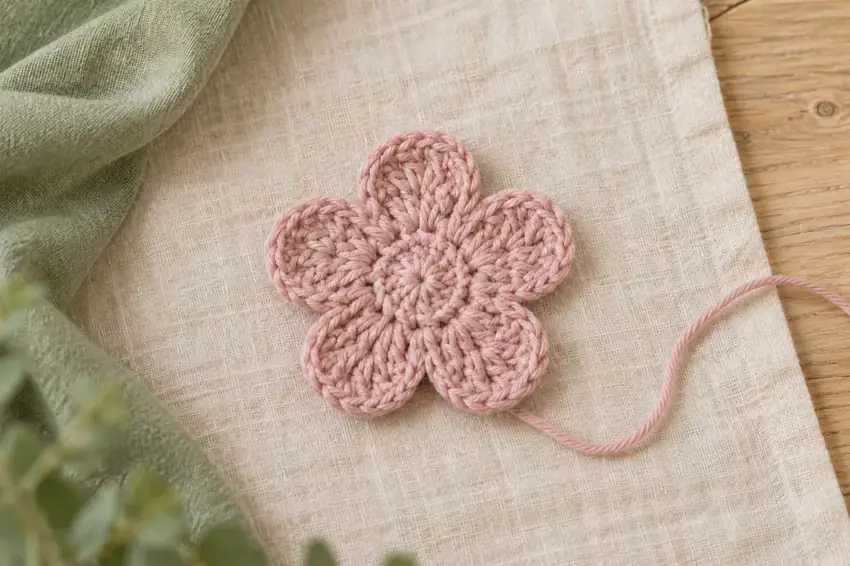
- A petal consists of (sl st, ch 2, 3 dc, ch 2, sl st) all anchored in one indicated round-1 stitch. The slip stitch in the following base stitch separates adjacent petals.
For a refresher, use our chain and single crochet lesson, double crochet lesson, or US / UK terminology referenceCalculate stitches from your gauge →.
Let's make it, step by step.
Read the full pattern once before starting. Optional checkboxes help you follow the sequence for this page view only.
- One chain-four ring
Chain 4. Sl st in the first chain to close a ring. Do not turn.
- 10 sc
Ch 1; it does not count. Make 10 sc into the ring opening, marking the first sc. Join with a sl st to the first sc. Neither the ch 1 nor joining sl st is a base stitch. Do not turn.
- One petal; base stitches 1–2 used
In round-1 stitch 1, the marked sc where you joined, work (sl st, ch 2, 3 dc, ch 2, sl st), anchoring all the stitches in that same sc. Then sl st in round-1 stitch 2.
- Four petals total; base stitches 1–8 used
Repeat the same two-stitch unit three times: a complete petal in base stitch 3 and separator sl st in 4; a petal in 5 and separator in 6; a petal in 7 and separator in 8. Each petal uses (sl st, ch 2, 3 dc, ch 2, sl st) in its one odd-numbered base stitch.
- Five petals; all 10 base stitches used
Work the final petal unit in base stitch 9, then sl st in base stitch 10. Do not start another repeat or add another joining stitch. Cut a usable tail, draw it through the live loop and secure gently.
Weave in the ring tail on the back. Weave the final tail too, or reserve it to sew the motif onto a chosen item. Arrange the petals gently and record the actual diameter of your sample.
| Petal | Work petal into base stitch | Separator slip stitch |
|---|---|---|
| 1 | 1 | 2 |
| 2 | 3 | 4 |
| 3 | 5 | 6 |
| 4 | 7 | 8 |
| 5 | 9 | 10 |
Construction, finishing & helpful notes
Understand the ten-stitch center
The small center supplies ten base stitches. The odd-numbered stitches carry petals: 1, 3, 5, 7 and 9. The even-numbered stitches hold separating slip stitches: 2, 4, 6, 8 and 10. This gives five petals without skipping an unaccounted-for stitch or trying to fit a sixth repeat.
Work in joined rounds without turning. Use one color to focus on placement. This draft has not been maker-tested; size and flatness need checking in real yarn.
Know the three stitches before you begin
For a slip stitch, insert the hook, yarn over and draw through the indicated location and the live loop. For sc, insert, yarn over and pull up a loop, then yarn over and pull through both loops.
For dc, yarn over, insert, yarn over and pull up a loop: three loops. Yarn over and pull through two, then yarn over and pull through two again. Each petal has three separate dc in one base stitch, not a cluster closed together.
Make the ring and count before adding petals
Join the chain-four ring without twisting it. In round 1, make the sc into the ring opening, not into its individual chain links.
Mark the first sc. After the tenth, join to that first sc. The chain-one and joining slip stitch are not additional base stitches. Keep the marker in the first sc for round 2.
Work every petal into its assigned stitch
After joining round 1, begin the first petal in the first sc itself—the marked stitch where you just joined—not in the next sc. Make a slip stitch into that same base stitch, chain two, work three double crochets into it, chain two, and slip stitch into that same base stitch again. That completes one petal.
Now slip stitch into base stitch 2. The next petal goes into base stitch 3, followed by a separating slip stitch in base stitch 4. Continue the same placement map. Several actions enter a petal's base stitch, so open that stitch gently with your fingers instead of accidentally inserting into a chain-two space.
After the fifth petal in base stitch 9, make the separating slip stitch in base stitch 10. Stop there. You have completed the entire base round; do not repeat into stitch 1 and do not add an extra petal or a chain-one turn.
Finish without flattening the flower
Cut a usable tail, draw it through the live loop and secure gently. Weave the tails through supported stitches on the back. Reserve the final tail if needed for attaching the motif.
Arrange the petals with your fingers and inspect the center. Five petals with three actual dc apiece give fifteen dc in the petal round. There are also twenty petal chain stitches and fifteen slip stitches in that round: two anchor slip stitches per petal plus one separator per repeat. Those different stitch types are listed separately to prevent a misleading single total.
If a petal is missing, check the odd/even base map. If the flower cups or ruffles, first confirm ten center stitches and five complete petals, then evaluate your yarn, hook and tension with a fresh sample. Do not use forceful stretching or heat to disguise a counting error. Follow your yarn's care guidance for any gentle shaping.
Video help for the techniques
These external tutorials explain stitches or finishing used in this recipe. Follow this page for the project's exact counts, placement and assembly.
How to Crochet a Foundation Chain — Yarnspirations / Red Heart Design Team ↗How to Double Crochet (DC) — Yarnspirations / Red Heart Design Team ↗Weave In Ends in Crochet — Yarnspirations ↗Browse all technique references →Keep your next make a little easier.
Save yarn, hook, gauge and measurement notes using our free starter checklist.
Open the free checklist ↗