Churn dash quilt: a step-by-step tutorial for a 43 × 54-inch lap quilt
The classic churn dash block in mustard and charcoal: half-square-triangle corners, two-strip bar units and a plain center, set with sashing, cornerstones and a border. Diagrams for every step.
Complete guide · No signup required
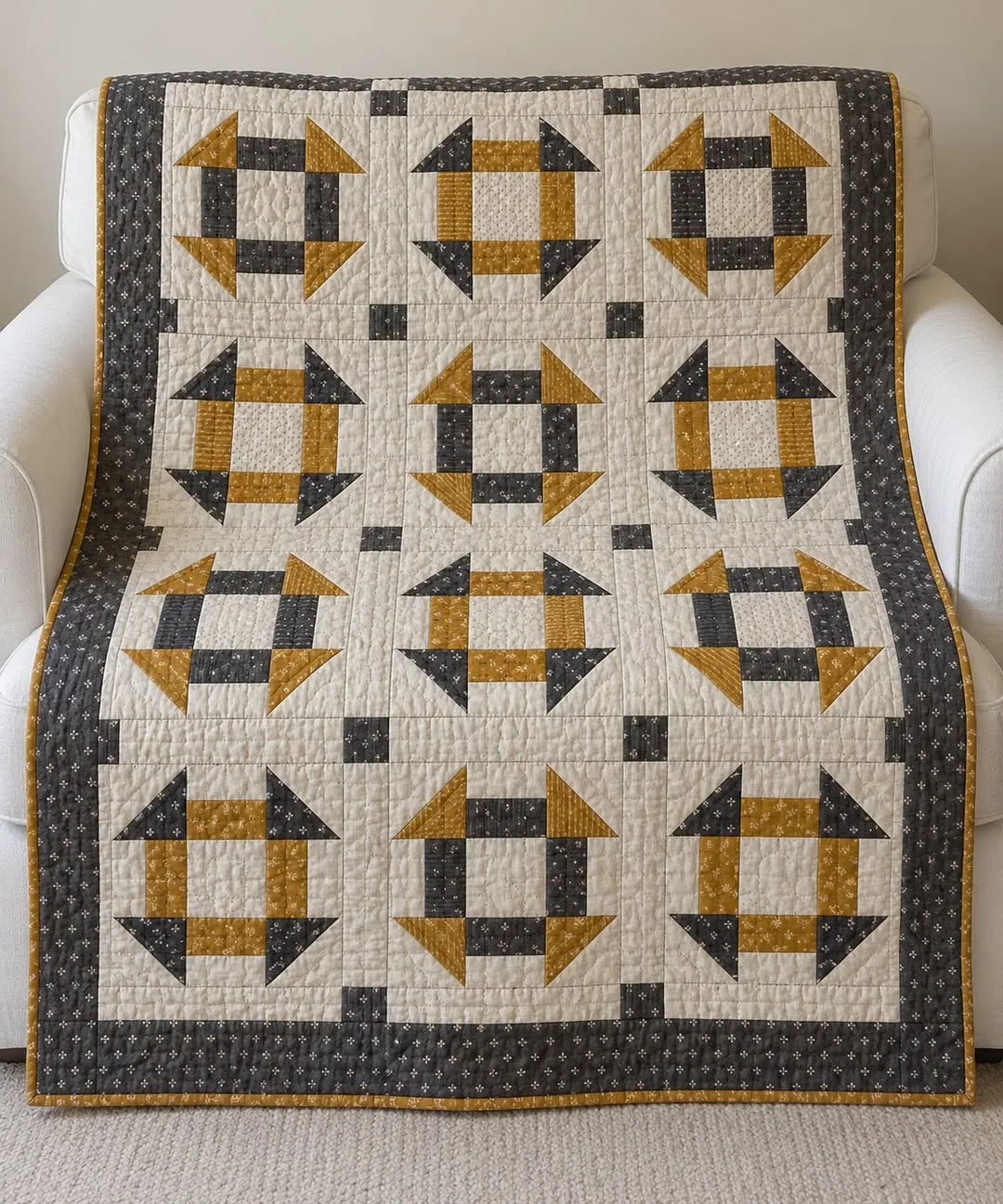
A farmhouse classic
The churn dash block is named after the wooden butter churn found in old farmhouse kitchens: the shape in the middle of the block looks like the dasher that turned the cream. It is one of the most traditional blocks there is, and one of the friendliest to sew.
In this quilt, mustard and charcoal take turns: in one block the corners are mustard and the bars charcoal, in the next block it is the other way around. Cream sashing with little charcoal squares at the crossings, called cornerstones, gives every block room to breathe.
Words used in this tutorial
Here are the terms you will meet. Come back to this list whenever you need it.
- HST (half-square triangle): a square made of two triangles.
- Bar unit: a square made of two rectangles sewn side by side.
- Sashing: narrow strips between the blocks.
- Cornerstone: a small square where sashing strips cross.
- Seam allowance: always ¼ inch. All sizes below include it.
Quilt size and plan
Each block finishes at 9 inches (9½ inches before sewing). The sashing finishes 2 inches wide and the border 4 inches. Three blocks across and four down, with sashing between and around the blocks, plus the border, make a 43 × 54-inch lap quilt.
| Part | How many | Size before sewing |
|---|---|---|
| Churn dash blocks | 12 (6 of each color way) | 9½ × 9½ in |
| Sashing strips | 31 | 2½ × 9½ in |
| Cornerstones | 20 | 2½ × 2½ in |
| Border | 4 sides | 4½ in wide |
| Quilt | 1 | 43 × 54 in finished |
Fabric and supplies
Amounts assume fabric about 42 inches wide with at least 40 usable inches, and include a little extra.
- Cream background: 1½ yards
- Mustard: ½ yard
- Charcoal: 1¼ yards (blocks, cornerstones and border)
- Binding (mustard, as in the photo): ½ yard
- Backing: 3½ yards; batting about 51 × 62 inches
- Rotary cutter, mat, ruler, fabric pencil, thread, pins, iron and sewing machine
Step 1: Cut the pieces
Each block uses two colors: color A for the corners and color B for the bars. For six blocks, A is mustard and B is charcoal; for the other six, A is charcoal and B is mustard.
| For one block | Fabric | Cut |
|---|---|---|
| Corners | Color A | 2 squares 3⅞ in |
| Corners | Background | 2 squares 3⅞ in |
| Bars | Color B | 4 rectangles 2 × 3½ in |
| Bars | Background | 4 rectangles 2 × 3½ in |
| Center | Background | 1 square 3½ in |
Step 2: Make the corner and bar units
Corners: draw a diagonal on the wrong side of each background 3⅞-inch square, place it on a color-A square, sew ¼ inch on both sides of the line, cut on the line and press toward the color. Trim each HST to 3½ inches. One block needs four.
Bars: sew each color-B rectangle to a background rectangle along the long edge. Press toward the color. Each bar unit is a 3½-inch square. One block needs four.
Step 3: Lay out the block
Put the background center in the middle. Place a bar unit on each side with its colored bar touching the center square. Put an HST in each corner with its colored triangle in the outer corner, so the long diagonal faces the center.
This is the moment to compare with the photo: the colored bars form a frame around the center, and the corner triangles point outward like little arrows.
Step 4: Sew the block
Sew the three units of each row together. In the top and bottom rows, press the seams toward the bar unit in the middle. In the middle row, press the seams toward the two bar units on the sides. The seams of neighboring rows then face opposite directions and lock together.
Join the rows, pinning at each seam. The block measures 9½ inches square. Make six blocks with mustard corners and six with charcoal corners.
Step 5: Make the sashing rows
A sashing row is: cornerstone, sashing strip, cornerstone, sashing strip, cornerstone, sashing strip, cornerstone. Make five sashing rows. Press toward the sashing strips.
A block row is: sashing strip, block, sashing strip, block, sashing strip, block, sashing strip. Make four block rows, alternating the color ways like a checkerboard. Press toward the sashing strips, so the seams nest with the sashing rows.
Step 6: Join the rows and add the border
Start with a sashing row, then a block row, and keep alternating until you end with a sashing row: five sashing rows and four block rows. Match the cornerstones with the seams of the block rows and pin there. The quilt center measures 35½ × 46½ inches.
For the border, join the charcoal 4½-inch strips. Measure through the middle from top to bottom, cut two side borders and sew them on. Then measure across the middle, cut the top and bottom borders and sew them on.
Step 7: Quilt and bind
Layer, baste and quilt. An all-over meander or straight lines along the sashing both look lovely. For the binding you need about 206 inches: the 194-inch edge plus 12 inches. Six 2½-inch strips of mustard are enough, and they make a cheerful thin frame around the charcoal border.
Fixing common problems
The churn dash is forgiving, but watch for these.
- Corner triangles pointing in: an HST is turned the wrong way. The colored triangle belongs in the outer corner.
- Bars on the outside: a bar unit is turned around. The colored bar touches the center.
- Block smaller than 9½ inches: the HSTs were trimmed too small or the seams were wide. Measure each unit (3½ inches).
- Cornerstones not lining up: pin at every cornerstone before sewing the long seams.
Final thoughts
The churn dash has been loved for generations because it is simple, sturdy and handsome in any colors. Take your time with the layout, measure each unit, and your farmhouse quilt will come together beautifully. Follow Cozy Pattern Lane on Facebook and Instagram (@cozypatternlane) for more quilting tips.